
+86-731-85666876
Liuyang High-Tech Industrial Area, Changsha China


Views: 0 Author: Site Editor Publish Time: 2026-07-23 Origin: Site


Unplanned mill downtime severely disrupts plant productivity in mineral processing environments. Premature wear part failure stops production cold and forces emergency maintenance interventions. Operators face constant pressure to maximize grinding uptime and optimize throughput. You must evaluate if upgrading wear components makes operational sense for your specific facility. The primary challenge lies in balancing material properties against your site's unique impact forces and abrasion parameters. Many facilities struggle to determine if Chrome-Molybdenum alloys justify their selection over traditional materials. We provide a transparent, metallurgical-based framework for evaluating these advanced liners. We explore alternative wear materials and highlight optimal deployment strategies for your plant. You will discover how to assess impact forces, analyze abrasion types, and mitigate structural risks. We explain the core science behind heat treatment and alloy composition. Ultimately, you will learn how to match specific alloy structures to your exact operational demands, ensuring maximum reliability and optimal mill performance.
Balance of Properties: CrMo alloys bridge the gap between the high impact resistance of manganese steel and the extreme abrasion resistance of white iron.
Ideal Environments: Best suited for large-diameter mills, specifically as a primary ball mill liner, handling moderately to highly abrasive ores with medium-to-high impact forces.
Alternative Contexts: In extreme abrasion zones with low impact, high-chrome or a bi-metal mill liner may offer superior ROI; CrMo is the choice when catastrophic fracture is a primary risk.
System Integration: Upgrading mill liners should be part of a whole-plant wear strategy, encompassing transition points like a feeding chute liner(Cr27+ZTA).
Standard liners often force operators into a difficult engineering compromise. You either sacrifice impact resistance to gain wear life, or you lose abrasion durability to prevent catastrophic fracture. Understanding these material limitations helps you identify why standard solutions fail in specific grinding environments.
Standard austenitic manganese steel, commonly known as Hadfield steel, requires heavy impact to function correctly. When large ore chunks strike the surface, the outer layer work-hardens significantly. The core remains ductile and absorbs the shock. However, in lower-impact grinding environments, it suffers rapid abrasive wear. If the grinding media simply slides across the steel, the surface never hardens. The soft matrix wears away quickly. Furthermore, continuous light impacts cause peening. The steel spreads and deforms, locking adjacent liners together and complicating maintenance removals.
Standard high-chrome white iron excels in pure abrasion resistance. It contains massive chromium carbides that easily deflect sliding rock and sand. Despite this extreme hardness, the material remains highly susceptible to cracking under heavy impact. If you drop a five-inch grinding ball onto a high-chrome plate, it often shatters. Catastrophic failure occurs when large media continuously hammer the brittle matrix. Broken pieces fall into the charge, leaving the vulnerable mill shell exposed to direct damage.
Selecting the wrong alloy creates a cascade of operational problems. Premature replacement increases your total number of scheduled shutdowns. Localized spalling ruins the engineered liner profile prematurely. When the lifter angle degrades rapidly, the ball trajectory changes. Grinding media begins crashing into the toe of the charge incorrectly. This poor trajectory reduces mill throughput and severely diminishes grinding efficiency.
Common Mistakes:
Specifying manganese steel for secondary milling stages where impact forces remain too low for work-hardening.
Installing high-chrome iron in primary SAG mills where large media causes immediate structural fracturing.
Ignoring early signs of localized spalling, which rapidly degrades the overall lift trajectory.
Engineers developed chrome-moly alloys to bridge the gap between extreme toughness and extreme hardness. A properly cast CrMo Mill Liner solves the inherent limitations of both manganese and high-chrome iron.
Chromium provides the essential foundation for wear resistance. It forms dispersed hard carbides within the steel matrix. These carbides deliver crucial structural hardness. They actively resist gouging abrasion caused by sharp rock fragments. By integrating chromium, metallurgists elevate the baseline hardness well beyond standard carbon steels.
Molybdenum acts as the critical stabilizing element in thick castings. It increases the depth of hardenability throughout the part. When foundries cast thick lifter bars, the core often cools slower than the surface. Molybdenum ensures the core hardens uniformly. It maintains vital toughness deep inside the metal and actively prevents internal cracking during extreme heat treatment cycles.
The chemical composition alone does not guarantee performance. The final durability relies entirely on precise quenching and tempering processes. The goal involves creating a fully martensitic matrix. Martensite delivers incredible strength and wear resistance. If the foundry cools the casting too slowly, pearlite forms instead. Pearlite represents a softer, weaker structure that degrades rapidly in a mill. You must establish strict vendor-evaluation criteria regarding their heat treatment capabilities.
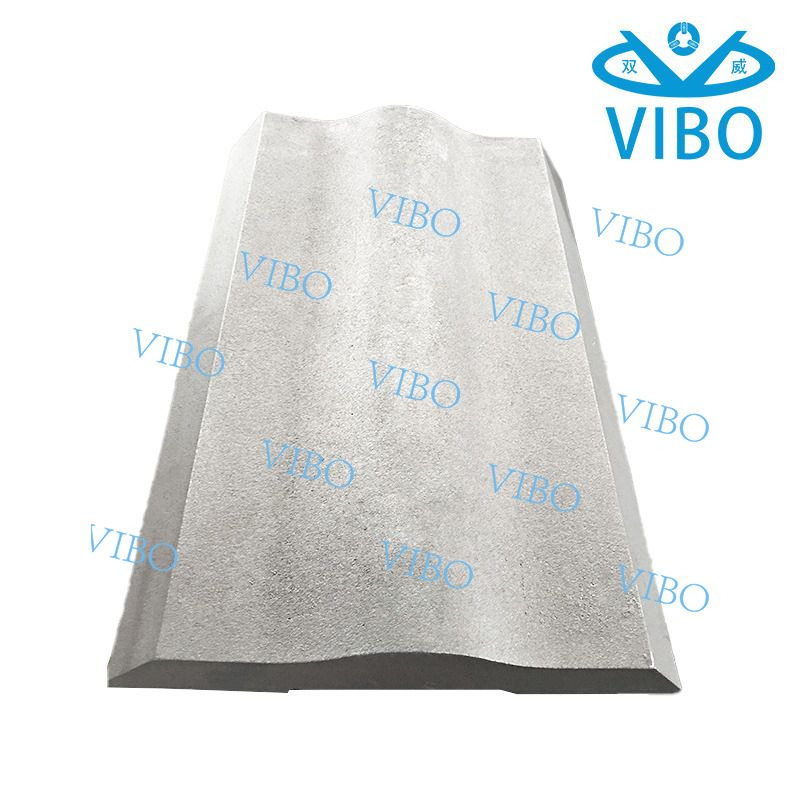
Deploying chrome-moly alloys requires matching the material characteristics to your exact operational parameters. Different mill types generate vastly different forces.
Semi-Autogenous (SAG) and Autogenous (AG) mills represent brutal environments. Massive ore chunks drop continuously onto the mill shell. Discharge grates and lifter bars must withstand immense pounding. Evaluate chrome-moly steel for these components because the impact dictates high yield strength requirements. The alloy resists severe deformation and handles heavy loads without fracturing.
A well-designed Ball Mill Liner made of chrome-moly often outperforms manganese significantly. Secondary grinding stages use smaller grinding media. The cascading action creates medium impact but generates intense sliding abrasion. Manganese fails to work-harden here. Chrome-moly thrives in these conditions. It maintains its engineered lifter height longer, ensuring the media trajectory remains optimal for efficient grinding.
You must carefully analyze your feed material before specifying an alloy.
Silica Content: High silica ores act like sandpaper, shredding softer steels instantly. Chrome-moly offers superior resistance to this abrasive action.
Ore Hardness: Check the Bond Work Index. Harder ores demand a harder matrix to prevent rapid gouging.
Corrosivity: Assess the pH level of your slurry. Chrome-moly handles mild corrosion well. However, highly acidic wet milling might force you to specify rubber composites instead.
Selecting the optimal wear material requires a systematic comparison. The following framework helps you evaluate alternatives based on physical properties and operational constraints.
Wear Material Evaluation Chart
Material Type | Abrasion Resistance | Impact Resistance | Ideal Application |
|---|---|---|---|
CrMo Alloy Steel | High | Medium-High | Primary ball mills, SAG grates |
Manganese Steel | Low (unless hardened) | Extreme | Primary crushers, extreme impact zones |
High-Chrome Iron | Extreme | Low | Low-impact, high-sliding zones |
Bi-metal Composites | Extreme (Targeted) | Medium | High-wear transfer points, chutes |
Manganese remains the standard for massive impact, but it has strict limitations. Choose chrome-moly when the impact is simply insufficient to work-harden manganese. You should also select it when dimensional stability is absolutely required. Chrome-moly prevents the liner spread and severe peening that often makes manganese removals dangerous and time-consuming.
A Bi-metal Mill Liner utilizes highly abrasion-resistant white iron inserts embedded in a ductile steel backing. It offers extreme targeted wear resistance. However, complex grate designs and intricate lifter shapes are difficult to manufacture in bi-metal. Choose chrome-moly for more uniform wear profiles, highly complex casting shapes, and straightforward installation requirements where composite manufacturing proves impractical.
High-chrome iron dominates pure sliding abrasion applications. Unfortunately, it cannot survive heavy pounding. Specify chrome-moly when the risk of liner fracture from large ball charges outweighs your need for maximum abrasion resistance. A cracked liner causes immediate, unscheduled shutdowns, making toughness a mandatory requirement.
Deploying a new alloy introduces mechanical and operational variables. You must address specific installation risks and establish robust tracking methodologies to ensure success.
Alloys feature different specific gravities. Chrome-moly castings may differ in weight compared to your previous manganese liners. You must discuss how casting tolerances affect total mill weight limits. Heavier shell loads place additional stress on trunnion bearings. Calculate these bearing loads accurately prior to installation. Furthermore, ensure your lifting equipment safely handles the specific dimensions and weights of the new castings.
You cannot simply install liners and forget them. Highlight the importance of regular 3D scanning. Technicians map the internal wear profile during scheduled stops. This predictive maintenance strategy ensures the lifters maintain their optimum trajectory. If the grinding media falls in the wrong location, efficiency drops. Tracking the profile allows you to schedule replacements exactly when the geometry fails to lift the charge correctly.
You must vet your foundry rigorously. A poor casting fails rapidly regardless of its chemical name.
Request comprehensive chemical composition certificates for every batch poured.
Demand non-destructive testing (NDT) reports, including ultrasonic and magnetic particle inspections, to identify internal voids.
Verify heat treatment logs to ensure the quenching and tempering processes reached the exact temperatures required for martensite formation.
Plant efficiency relies on continuous material flow. A durable mill lining provides little benefit if downstream components fail prematurely. You must frame the mill liner as just one specific component within a comprehensive, site-wide wear strategy.
Analyze your entire grinding circuit. The durability of the mill discharge must align with the wear life of the receiving hoppers. If you upgrade the mill to run for twelve months continuously, the surrounding infrastructure must also survive for twelve months. Mismatched component lifespans force unnecessary partial shutdowns.
Transition points handle brutal sliding abrasion as crushed ore leaves the mill. Discuss matching mill output durability with these downstream components. For example, utilize an advanced Feeding Chute Liner(Cr27+ZTA) at critical transfer points. This technology embeds Zirconia Toughened Alumina ceramic directly into a high-chrome metallic matrix. It handles the severe sliding abrasion effortlessly. By deploying advanced composites here, you ensure the mill and the chute share perfectly aligned maintenance schedules.
Best Practices for Wear Management:
Map all high-wear transition points immediately following the mill discharge.
Synchronize replacement intervals so that chutes, screens, and mill liners are serviced during a single planned outage.
Standardize inspection protocols across both grinding and material handling departments.
Chrome-moly alloys are not a universal cure for all wear problems, but rather a highly engineered compromise between necessary toughness and required hardness. By understanding the specific metallurgical mechanisms, you can accurately predict material behavior inside your mill. Successful adoption requires carefully matching the specific alloy grade, including its precise carbon, chrome, and molybdenum ratios, to your exact ball charge size and ore characteristics. We recommend conducting a localized wear analysis or running a pilot test using a single test ring before committing to a full mill reline. This proactive approach validates your assumptions and secures reliable, long-term operational performance.
A: The standard hardness ranges from 35 to 45 HRC for higher-toughness applications, and up to 45 to 55 HRC for maximum abrasion resistance. The exact hardness depends heavily on the specific carbon content and the exact tempering temperatures used during the final heat treatment process.
A: Welding this alloy is metallurgically difficult. The high hardenability introduces severe cracking risks in the heat-affected zone. Any temporary repair requires strict pre-heating, controlled post-weld cooling, and specific low-hydrogen consumables to prevent immediate structural failure.
A: It holds its engineered profile significantly longer than standard manganese steel. By maintaining the designed lifter height and angle, it preserves the optimal ball trajectory. This consistent lift optimizes grinding efficiency over time and keeps mill throughput high.
A: It possesses limited corrosion resistance. While it handles mildly corrosive environments well, highly acidic wet milling accelerates the degradation of low-alloy steels. In extreme acidic conditions, higher chrome alloys or specialized rubber composite liners might be necessary.

