
+86-731-85666876
Liuyang High-Tech Industrial Area, Changsha China


Views: 0 Author: Site Editor Publish Time: 2026-07-16 Origin: Site


Unplanned downtime at the primary gyratory crusher bottleneck disrupts your entire downstream circuit. When primary comminution fails or underperforms, plant profitability takes an immediate hit. The stakes are simply too high to ignore.
Selecting a Gyratory Crusher Concave Segment is not a routine consumable purchase. It represents a strategic engineering decision directly influencing nip angle stability. The right choice dictates throughput capacity and energy consumption for the entire crushing process. You cannot afford to leave this decision to chance.
This guide provides plant managers and procurement engineers an evidence-based evaluation framework. You will learn to evaluate material metallurgy, interpret complex wear data, and plan precise replacement cycles. Read on to discover how you can optimize your primary crushing performance today.
Material selection must be driven by feed rock characteristics; balancing impact resistance (Manganese) with extreme abrasion resistance (White Iron And Ni-hard Casting).
Proactive wear pattern analysis (informed by discrete element method/DEM principles) prevents choke-feed inefficiencies and protects the mantle.
Procurement evaluation requires verifying dimensional accuracy, metallurgical consistency, and strict quality control standards to ensure OEM-level or better compatibility.
Strategic replacement planning minimizes operational disruption through condition-based monitoring rather than relying solely on arbitrary tonnage limits.
Degraded concave segments alter the crushing chamber geometry drastically. When the profile loses its original shape, operators face immediate consequences. Oversized product begins passing through the gap. This oversized rock increases the recirculating load downstream. Your secondary crushers must then work harder, consuming excess energy. Eventually, reduced throughput chokes the entire plant's production rate. Operators often notice an increased power draw as the machine struggles to crush effectively.
Unscheduled maintenance presents harsh financial realities. A concave segment can fail prematurely due to internal casting defects. Improper material selection also leads to sudden cracking. When a primary crusher stops unexpectedly, the whole site grinds to a halt. Emergency shutdowns cost thousands of dollars per hour. Replacing broken Wear Liners under pressure increases safety risks for maintenance crews.
Systemic wear spreads beyond the initial point of failure. Localized wear on the concave forces the mantle to compensate. The eccentric assembly absorbs uneven stresses. This imbalance accelerates wear across other critical components. Bearings run hotter, and the main shaft experiences abnormal deflection. You must view the crushing chamber as a unified ecosystem.
Crusher Performance Chart: Optimal vs. Degraded Segments
Performance Metric | Optimal Concave Profile | Degraded Concave Profile |
|---|---|---|
Throughput Capacity | 100% (Design Standard) | Reduces by 15-30% |
Power Consumption | Stable and predictable | Frequent power draw spikes |
Product Gradation | Consistent sizing | High percentage of oversized rock |
Component Stress | Balanced across the mantle | High localized eccentric stress |
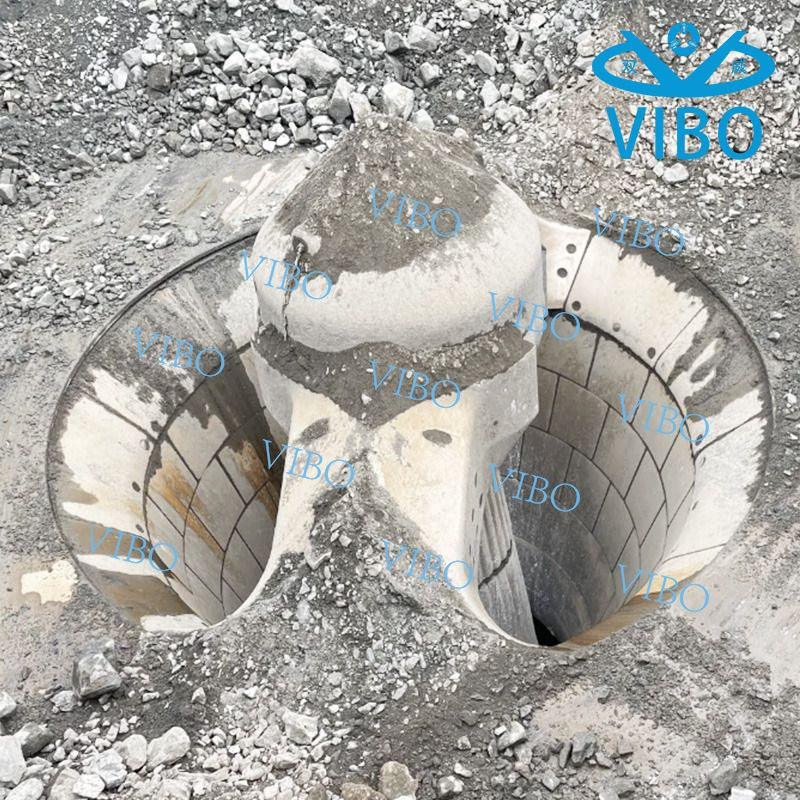
Choosing the correct alloy dictates the lifespan of your liners. You must match the material to your specific feed rock characteristics.
Manganese steel remains the industry standard for high-impact applications. It suits standard primary crushing environments perfectly. The alloy possesses unique work-hardening properties. As heavy rocks impact the surface, the outer layer hardens significantly. Meanwhile, the core remains highly ductile. This ductility prevents catastrophic brittle failure under massive compressive loads. If your site processes large, hard boulders, manganese steel offers the safest reliability.
Extreme abrasion environments demand a different metallurgical approach. White Iron And Ni-hard Casting excels against highly siliceous ores. These materials offer exceptionally high initial hardness. They resist sliding abrasion better than standard manganese. However, you must manage impact forces carefully. High hardness brings increased brittleness. You cannot use these castings where massive, uncrushable objects enter the feed. The trade-off requires balancing potential lifespan extension against the risk of cracking.
Tier-one foundries do not rely on one-size-fits-all formulas. They customize alloys to match specific operational profiles. Foundries adjust critical elements to optimize performance:
Carbon content: Increased to elevate baseline hardness for aggregate quarrying.
Chromium additions: Boosted to enhance wear resistance in highly abrasive hard rock mining.
Molybdenum ratios: Adjusted to improve depth hardening and prevent premature yielding.
Heat treatment cycles: Tailored to refine the grain structure for maximum toughness.
Proactive wear pattern analysis prevents catastrophic failures. You must distinguish between normal degradation and pathological wear.
Uniform wear indicates an optimized feed distribution. The concave thins evenly across its vertical profile. Conversely, pathological wear manifests as localized cupping or bell-mouthing. Cupping occurs when abrasive fines concentrate in a specific zone. Bell-mouthing happens at the bottom of the chamber. These uneven profiles destroy the machine's efficiency.
Wear fundamentally alters the internal chamber geometry. It changes the nip angle between the mantle and the concave. An incorrect nip angle causes rocks to slip instead of crush. Wear also shifts the choke point higher or lower inside the chamber. This shift directly affects the gradation of the crushed output. When the choke point moves, the crusher cannot maintain its optimal closed-side setting (CSS).
Modern plant managers rely on data to improve efficiency. Analyzing discarded wear liners provides invaluable insights. You can use principles akin to Discrete Element Method (DEM) wear tracking. DEM helps visualize how rock flows and grinds against the walls. By tracking these patterns, you can implement effective adjustments.
Audit the feed distribution to ensure rock enters the chamber centrally.
Adjust the closed-side setting (CSS) regularly to compensate for continuous liner thinning.
Redesign future liner profiles based on the exact location of high-wear zones.
Segment the replacement strategy so you only replace the fastest-wearing tiers.
Sourcing replacement components requires rigorous supplier vetting. You must look beyond initial pricing and demand engineering excellence.
Precise casting tolerances are non-negotiable. The concave segments must align exactly with the crusher shell. A poor fit leaves gaps between the liner and the backing material. These gaps cause the backing epoxy to crack and fail. Once the backing fails, the concave segment flexes under pressure. Flexing leads directly to premature cracking. Premium aftermarket suppliers utilize advanced 3D scanning to guarantee a perfect fit.
You cannot determine casting quality through visual inspection alone. The evaluation must center around non-destructive testing (NDT) capabilities. Reputable suppliers conduct ultrasonic testing to detect deep internal voids. They use magnetic particle testing to identify microscopic surface cracks. These tests guarantee the absence of internal shrinkage. Zero-defect quality ensures the segment performs reliably under maximum crushing loads.
Sourcing multiple wear parts from a single capable foundry streamlines your procurement. Top-tier foundries supply a broader range of components for the entire circuit. For example, procuring reliable Impact Crusher Parts alongside your gyratory segments ensures consistent metallurgy across the plant. This consolidation reduces administrative burdens. It also builds a stronger technical partnership with the foundry engineers.
Supplier Evaluation Criteria Table
Evaluation Metric | Basic Foundry | Premium Supplier |
|---|---|---|
Tolerances | Standard sand casting | CNC machined fitment zones |
Quality Control | Visual inspection only | Full NDT (Ultrasonic/Magnetic) |
Material Data | Generic alloy charts | Certified chemical composition reports |
Engineering Support | None | Wear profiling and profile redesign |
Replacing liners based on calendar days causes unnecessary downtime. You need a strategic, condition-based maintenance protocol.
Move beyond basic tonnage benchmarks immediately. Different ore seams vary wildly in abrasiveness. Instead, measure liner thickness during every scheduled shutdown. Plant operators should track power draw spikes carefully. When the crusher draws consistently higher amperage, the nip angle has degraded. These data points allow you to time replacement intervals precisely. You maximize the wear metal utilized while avoiding catastrophic failure.
Extracting segmented concaves involves massive heavy rigging. Safety protocols must dictate every step of the process. Maintenance crews require specialized lifting tools to handle the tonnage. Handling backing compounds safely is equally critical. Epoxy backing chemicals generate heat during curing. Crews must wear appropriate PPE. If your site uses backing-less fits, ensure the mating surfaces remain completely free of dust and debris.
Installing new segments demands meticulous attention to detail. Follow these actionable steps to ensure a secure fit:
Clean the crusher shell thoroughly to remove old backing residue.
Seat the lower tiers first, ensuring perfectly level alignment.
Verify the correct interlocking of all segmented joints to prevent shifting.
Pour the epoxy backing compound evenly to avoid trapping air pockets.
Allow proper curing times based on ambient temperature before restarting the crusher.
Maximizing the lifespan of a gyratory crusher concave segment requires strict engineering discipline. You must align metallurgical properties with your specific ore characteristics. Actively managing wear profiles prevents secondary damage to the crushing chamber. A proactive approach transforms a simple maintenance task into a strategic operational advantage.
Take the following action-oriented next steps:
Audit your current wear liner performance using laser scanning or ultrasonic thickness gauges.
Identify whether cupping or bell-mouthing is reducing your daily throughput.
Partner with foundries that provide transparent material data and rigorous QA/QC documentation.
Transition from tonnage-based replacements to condition-based monitoring programs.
A: Lifespan varies heavily based on feed abrasiveness, crushing ratio, and selected material. Standard manganese might last six months in hard rock, while specialized alloys can double that. You should focus on tracking wear rates per million tons processed rather than counting calendar days.
A: Segmented designs simplify the logistics of manufacturing, transporting, and installing massive wear parts. Additionally, they allow you to replace only specific tiers. The lower crushing zone often experiences accelerated wear, so you can swap those segments without replacing the entire chamber.
A: Liner thinning effectively widens the CSS. To maintain consistent product size, operators must raise the main shaft. Eventually, raising the shaft reduces the overall crushing volume inside the chamber, which decreases your maximum daily throughput.
A: Yes. Premium aftermarket suppliers utilize advanced reverse engineering and strict metallurgical controls. By applying verified casting processes and full NDT testing, top-tier foundries routinely produce segments that meet or exceed original OEM tolerances and lifespans.

