
+86-731-85666876
Liuyang High-Tech Industrial Area, Changsha China


Views: 0 Author: Site Editor Publish Time: 2026-07-27 Origin: Site


Transfer points often become the primary bottlenecks in bulk material handling facilities. Premature failure of a feeding chute liner dictates unexpected facility downtime and drives up daily maintenance overhead. Specifying liners based solely on initial procurement cost leads to catastrophic substrate damage. You risk massive material spillage when site-specific wear mechanics, such as extreme impact versus sliding abrasion, go unchecked.
We aim to provide plant engineers and procurement teams with an evidence-based framework for evaluating these critical components. You will learn how to accurately evaluate, shortlist, and implement the correct wear materials. This guide optimizes high-tonnage, severe-abrasion environments for maximum operational reliability and extended lifecycle performance.
Total Cost of Ownership (TCO) in chute design is driven by installation frequency and unplanned outage hours, not per-ton material costs.
High-impact zones and high-abrasion zones require divergent material strategies; hybrid solutions like the Feeding Chute Liner(Cr27+ZTA) bridge this gap for dual-threat environments.
60% of premature liner failures stem from improper fastening methods and substrate fatigue, not the wear material itself.
Localized wear patterns demand modular integration of supplementary protection, such as strategically placed chocky bars.
Understanding specific wear mechanics remains the first step in solving premature equipment failure. You must distinguish between kinetic energy transfer and frictional wear. Heavy ore dropping at 90 degrees transfers immense kinetic energy. This direct impact crushes standard metallic structures quickly. Conversely, abrasive fines sliding down a surface at 45 degrees create continuous frictional wear. This mechanism steadily erodes the surface layer of the metal over time. High-capacity transfer points often suffer from both forces simultaneously.
Engineers must shift their primary success metric away from initial capital expenditure. The true cost of failure involves calculating hourly downtime costs plus emergency maintenance labor. You compare these figures against the expected operational lifespan of the installation. A cheaper steel plate might save funds today, but it bleeds operational budgets through frequent replacements and lost production shifts.
A successful implementation must yield highly predictable maintenance cycles. It should guarantee zero structural substrate damage to the underlying steel frames. Furthermore, it must optimize material flow velocity without creating restrictive bottlenecks. Achieving these criteria ensures your processing plant operates at peak profitability.
Choosing the right material requires understanding transparent trade-offs. Each material category serves specific environmental demands.
Standard abrasion-resistant (AR) steel provides a traditional baseline for many facilities. Facility managers often default to a basic Wear Plate for general applications.
Pros: They offer a low initial procurement cost. Fabrication and welding processes remain highly predictable for most onsite maintenance crews.
Cons: These plates remain prone to rapid gouging under heavy impact loads. They also present a high friction coefficient. This friction often causes sticky material hang-ups and severe blockages in humid conditions.
Elastomeric polymers offer distinct advantages for specific structural challenges.
Pros: Rubber absorbs kinetic energy exceptionally well. High drop zones benefit from this tramp-bouncing effect. These materials also offer significant noise reduction, improving workplace safety regulations.
Cons: Polymers degrade rapidly under sharp, cutting materials. High-temperature material flows will melt or deform them quickly, rendering them useless in hot-slag or sintered ore applications.
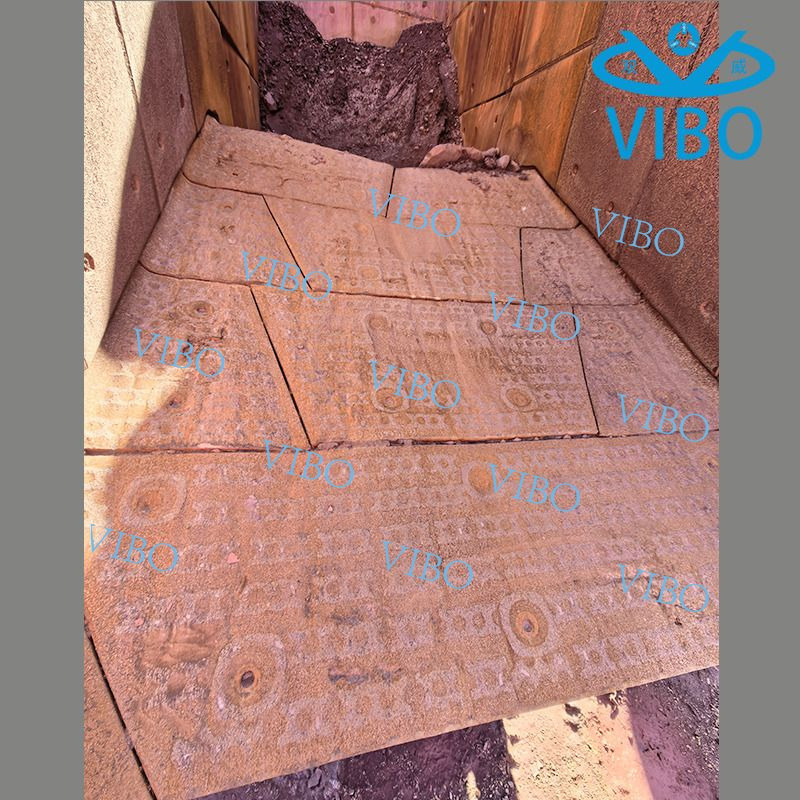
Modern engineering relies heavily on advanced composites to solve dual-threat environments. A prime example is the Feeding Chute Liner(Cr27+ZTA).
Mechanism: This technology fuses High-Chrome Cast Iron (Cr27) with Zirconia-Toughened Alumina (ZTA) ceramics. The Cr27 metallic matrix delivers massive structural impact resistance. Simultaneously, the embedded ZTA ceramics provide extreme sliding abrasion mitigation. The metal takes the physical punch while the ceramic deflects the scraping fines.
Best for: These composites dominate in primary crushers and run-of-mine (ROM) transfer points. Such environments routinely mix heavy, jagged boulders with highly abrasive silica fines.
Material Category | Impact Resistance | Sliding Abrasion Resistance | Friction Level |
|---|---|---|---|
Standard AR Steel | Medium | Medium | High |
Polyurethane | High | Low | Low |
Cr27+ZTA Composite | High | Extreme | Low |
Pure Alumina Ceramic | Low | Extreme | Ultra-Low |
Evaluating your site-specific conditions prevents costly misapplications. Plant engineers should use a strict framework before drafting procurement specifications.
Drop Height and Kinetic Energy: You must calculate the maximum impact force generated by falling ore. Drop heights exceeding 3 meters exponentially increase the kinetic energy measured in joules. These extreme heights generally disqualify pure ceramic tiles lacking a metallic matrix. Pure ceramics will shatter upon heavy impact without a shock-absorbing frame.
Material Granulometry: Analyze the lump size versus fine particle ratio. Sharp, large lumps require metallic matrices to resist deep gouging. Conversely, fine, high-velocity slurries require high-density ceramics to prevent rapid surface erosion. Understanding your granulometry dictates your macro-hardness requirements.
Chute Geometry and Flow Angle: Impingement angles directly dictate the wear profile. Material hitting a wall at 90 degrees causes impact destruction. Material sliding at 20 degrees causes frictional sanding. Low angles demand ultra-low-friction liners. This prevents ratholing, bridging, and costly flow blockages.
Operational Scalability: Always evaluate future production targets. Determine if your chosen material can scale safely if production tonnage increases by 15-20% in the next fiscal year. Undersized protection systems fail immediately under increased operational throughput.
Equipment rarely wears perfectly evenly. Localized flow vectors create isolated high-wear patches. Addressing these patches requires modular engineering rather than monolithic plating.
Engineers frequently employ dead-box designs alongside high-impact panels at steep transition points. A dead box intentionally traps a layer of material. This lets incoming bulk ore wear on trapped ore rather than the steel wall. This "rock-on-rock" friction naturally absorbs impact energy and dramatically extends the underlying equipment lifespan.
Complex, curved geometries suffer concentrated damage. Deploying a Chocky Bar or a wear button grid solves this efficiently. You can weld these flexible, modular pieces over localized high-wear patches. Full plate replacement wastes maintenance budgets when only a 10-inch section shows gouging. Modular reinforcement keeps equipment running between major shutdowns.
Innovative facilities leverage heavy-duty principles typically reserved for specialized machinery. Practices used for a massive Ball Mill Liner often translate well to ultra-severe chute applications. You can engineer custom, ultra-thick cross-sections directly at the exact point of impact. Synergizing metallurgy across different plant zones reduces inventory complexity and boosts overall reliability.
Best Practice: Standardize your liner block sizes (e.g., 300x300mm). This reduces custom inventory and simplifies rapid emergency replacements.
Best Practice: Map your wear patterns every month during the first quarter of installation to identify hidden impingement zones.
Common Mistake: Over-lining low-impact zones. Using premium bimetallic composites where standard rubber would suffice wastes critical engineering budgets.
Common Mistake: Ignoring gap tolerances. Leaving wide gaps between modular blocks allows abrasive fines to penetrate and wash out the underlying substrate.
Even premium materials fail if installed incorrectly. Real-world implementation presents several operational risks you must proactively mitigate.
Fastening methods represent the weakest link in any bulk handling installation. You must carefully choose between welded studs and countersunk bolts. Exposed bolt heads routinely shear off under high abrasive flow. Once a bolt shears, the heavy panel detaches. This detachment leads to cascading liner failure down the entire chute line. Always recess fasteners or cover them with specialized ceramic plugs to protect them from direct material contact.
Assess the structural frame of your feeding chute before upgrading materials. Heavy bimetallic composites weigh significantly more than basic rubber or thin steel. You require verified structural load capacities to safely mount them. A weak or corroded substrate frame will warp or collapse under the enhanced weight of high-chrome panels. Reinforce the skeletal structure prior to installation.
Design your liner arrangements for safe, localized replacement. Maintenance teams often work in dangerous, confined spaces. Using standardized modular blocks reduces manual lifting risks. Smaller blocks require less rigging and hoisting. This minimizes confined-space labor hours and drastically reduces injury rates during rushed outage intervals.
Uncrushed tramp iron poses severe threats to advanced ceramic matrices. A loose excavator tooth passing through the circuit delivers localized forces far exceeding normal operational parameters. You must mitigate catastrophic shattering. Install powerful overband magnetic separators upstream. This extracts tramp metal before it impacts your premium ceramic components.
Transforming engineering needs into actionable procurement steps requires rigorous supplier evaluation.
Do not accept marketing claims at face value. Demand empirical wear data from the manufacturer. Ask for verifiable case studies specifically matching your ore type and throughput. Require clear material composition certificates upon delivery. For instance, you should rigorously verify the specific chromium percentage in any high-chrome casting to ensure it meets structural requirements.
Modern procurement demands digital proof. Request Discrete Element Method (DEM) flow simulations from your prospective supplier. DEM software simulates particle trajectories and highlights specific impingement angles. Suppliers must prove their proposed layout will not disrupt bulk flow or cause unintended material dead-zones.
Never retrofit an entire plant on unproven promises. Implement a strict pilot protocol. Run a limited trial installation in a highly visible, high-wear localized zone. Monitor its performance closely for three to six months. Measure thickness loss using ultrasonic gauges. Validate performance thoroughly before committing capital to a full-plant retrofit.
Selecting the ideal wear components requires abandoning outdated, one-size-fits-all mentalities. Lifecycle value ties strictly to matching highly specific material properties to exact transfer point mechanics. A specialized bimetallic matrix handles dual-wear challenges effectively, while low-friction polymers solve entirely different geometry issues.
You must prioritize suppliers offering comprehensive engineering audits and DEM flow simulations alongside their raw materials. Purchasing hardware without structural context wastes capital. Proactive wear management directly increases facility profitability by keeping production lines moving continuously.
Take proactive steps today. Contact an experienced wear-engineering team for a site-specific audit. Request a customized lifecycle projection to see exactly how targeted material upgrades will reduce your annual downtime.
A: The addition of ZTA ceramics fundamentally changes the performance profile. These ceramics act as ultra-hard, wear-resistant aggregates embedded within a tough metallic matrix. The metal absorbs heavy physical impacts without shattering. Simultaneously, the exposed ceramic faces deflect sliding abrasion from sharp fines. This hybrid approach dramatically increases component lifespan in dual-threat environments where standard plates would gouge rapidly.
A: Utilizing standard block sizing significantly improves stock availability. Suppliers often hold standard squares in inventory, reducing lead times from months to weeks. Furthermore, modular bolted systems eliminate extensive onsite welding. This reduction in hot-work cuts installation hours drastically. Maintenance teams can easily swap localized blocks during short, routine planned outages rather than waiting for major annual shutdowns.
A: Yes, maintenance personnel frequently retrofit them over existing structures. However, you must verify welding compatibility between the base metal and the bar. Proper surface preparation remains critical; you must grind away rust and fatigued metal before welding. They serve as excellent emergency maintenance solutions. They add crucial protective thickness to specific gouges without requiring full panel removal.
A: Track overall expenses over a 12 to 24-month operational cycle. Calculate the cumulative cost of replacing old panels, emergency installation labor, and total revenue lost during unexpected outages. Compare this against the initial purchase price of the premium upgrade plus a single installation labor event. Premium options frequently reduce outage frequency, yielding substantial financial returns despite higher upfront costs.

